

The key to developing evidence-based policy is for policymakers to form trusted relationships with research experts who can apply their deep knowledge of the evidence base. But where to find them? APO Director, Brigid van Wanrooy, explains why APO is the perfect place to find a policy expert and exactly how to do it.

What’s stopping evidence-based policy?
So much has been written about evidence-based policy: why it’s important, how to do it, and how (on the rare occasion) it has been achieved. Despite all the good intent, it just isn’t happening as much as we talk about it.
The two most cited barriers to developing evidence-based policy are politics and time.
And by ‘politics’ I’m not just blaming politicians for not wanting to consider what the evidence base says when they are deciding what to do. The whole political process comprises a multitude of actors –opposing politicians, advisors, stakeholders, and policymakers – who each have their own motivations for bypassing the research evidence.
Which leads me to time – it’s often a lack of it that results in policymakers carrying out their work without due consideration of the research.
Evidence-based policy is a relational process
How do we overcome these barriers? Well, research has found mechanisms that strengthen the relationship between policymakers and researchers builds capacity to use evidence.
That is, a trusted working relationship with a research expert can support timely and pragmatic advice – key ingredients for overcoming the major barriers to evidence-based policymaking.
Yet a recent study has highlighted the “challenges faced by both the research and policy communities in knowing who to collaborate with in the research-policy translation process” (Williams et al. 2024:8).
APO: an excellent source of experts for policy
APO – Australia and New Zealand’s largest repository of public policy and research documents published by organisations – is the perfect place to find a research expert to support evidence-based policy. There are three key reasons why.
- APO specialises in policy – across every topic you could possibly think of.
- The experts on APO have demonstrated a desire to engage a broader audience by publishing non-academic literature.
- The experts are from a range of organisations including universities, research institutes, think tanks and government.
How to find an expert on APO
APO specialises in making public policy and research discoverable and searchable, so it is easy to find a policy expert.
Go to APO and Search (top right-hand corner) for the type of expert you are looking for.

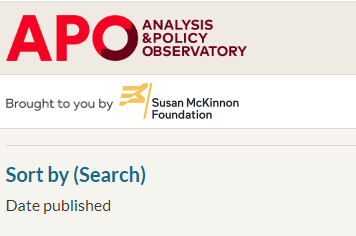
On the left-hand side of the search results, you will see the facets by which you can filter your search. APO’s database goes back to 2002 so you may want to first sort the results by clicking on date published.
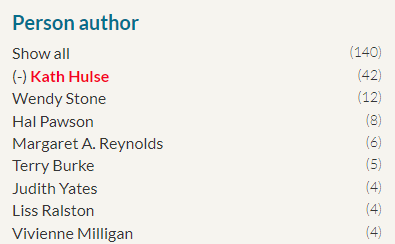
Once you have done that you can then scroll down to ‘Person author’. Here, you can see the experts who have the most publications on APO on your search topic. You can use the other filters such as ‘Subject’ and ‘Geographic coverage’ to refine your search.
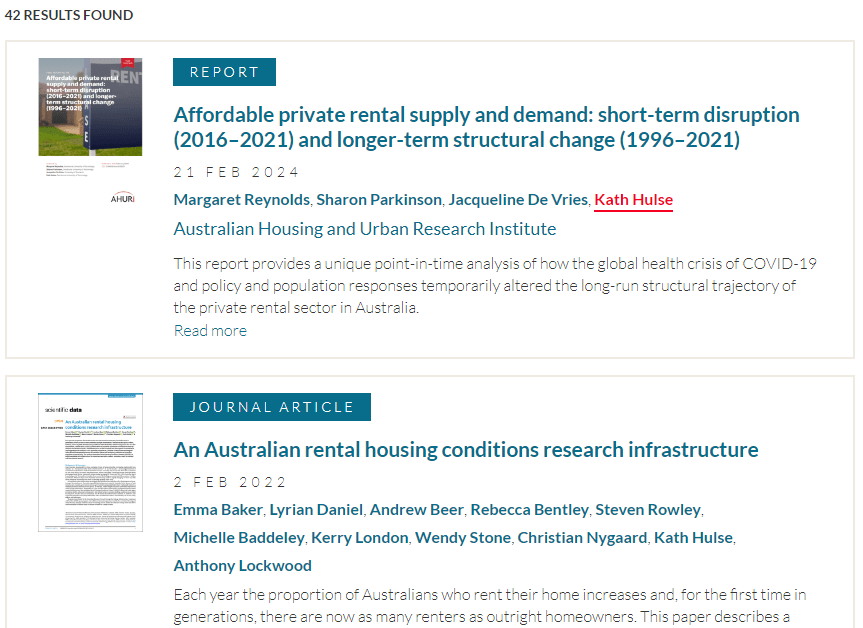
To find out more about an author on the list, click on their name to look at their publications meeting your search criteria. All the blue text on APO are links to further information. So, when you click on an author’s name within a publication record you will be taken to their profile page.
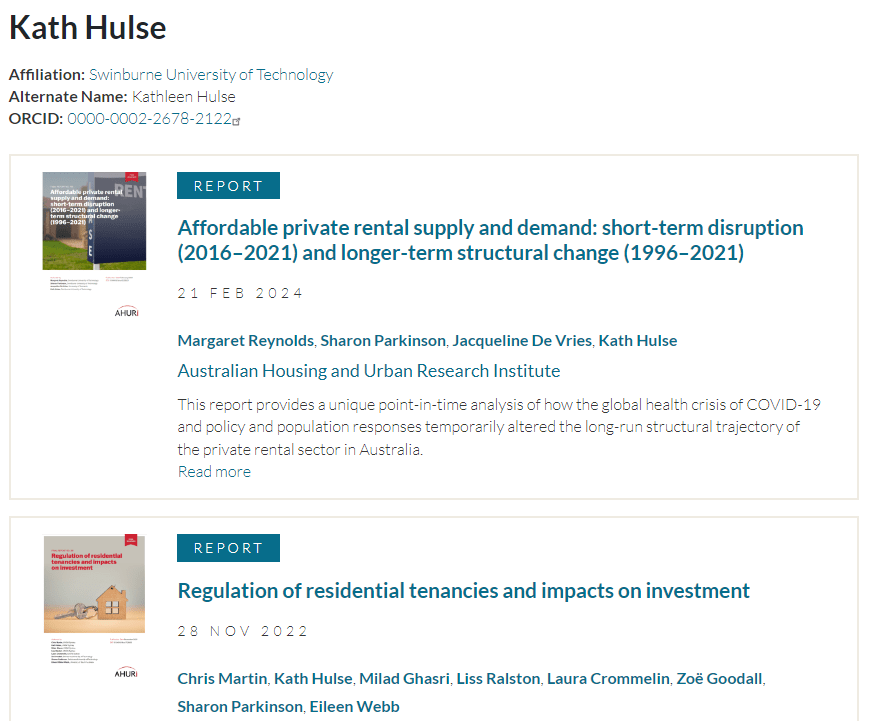
The author profile page contains all the publications by that expert on APO. It can also contain the organisation they are affiliated with (in this case, Swinburne University) and their Open Researcher and Contributor ID (ORCID) – this is another link that will take you to their ORCID page with all their publications including academic journal articles.
You could also click on ‘Australian Housing and Urban Research Institute’ to see the organisation’s profile page containing all the resources they published, authored, and are associated with; along with the organisation’s website.
Once you have discovered your research expert you should have no trouble finding their contact details with an internet search. And we expect they wouldn’t mind hearing from a policymaker wanting to know more about their research. After all, that’s presumably why they authored reports that you can find on APO.
Have a question? Email us.

 BLOG
BLOG 
You must be logged in to post a comment.